
You are on the edge of success in your business, but realize you are short of tools that will effectively control your relational data. A decade ago it was difficult to have software and handle finance management, but nowadays it is easy as anything. It is the golden age of software.
The software world has rapidly grown over the past decade, with the accounting software QuickBooks and SQL Server. These two software respond to all business needs, including all financial tasks and managing relational data. Examining the QuickBooks SQL Server evolution from small business to large business marks the understanding of their value. So, users choose QuickBooks SQL Server integration. This is not a trend, it’s a revolution in the business world, making a simple yet powerful promise to manage all the accounting activities.
What is QuickBooks SQL Server Integration?
QuickBooks and SQL Server- they are quite different, but the two software are used together in business. QuickBooks is best at managing financial tasks, while SQL Server tops in managing relational data. That’s why most users think of QuickBooks SQL Server integration. In this guide, we will dissect every aspect of these platforms, from their key features to all their benefits. More importantly, for the software users reading this article, we will cover the QuickBooks SQL Server integration that will help to reach their business to the topmost level.
QuickBooks
QuickBooks is an accounting software that is made for all types of businesses to manage their financial activities. It provides several tools, like an expenses tracking tool, an inventory tool, payroll management, etc. Users can also use QuickBooks to create invoices and financial reports. QuickBooks is known for its compatibility, strong integration, and best bank feeds. QuickBooks gained more popularity as it offers two best versions, which are preferred by every business. The two best versions of QuickBooks are QuickBooks Online and QuickBooks Desktop. You can choose between QuickBooks Online vs QuickBooks Desktop according to your business needs. QuickBooks offers a 30-day free trial and provides different subscription plans for each type of business.
SQL Server
SQL Server refers to relational database server management, which supports several transactions and data information. SQL is the structured query language used by all accounting professionals to manage databases and queries. SQL always ranks at the top for its data management process. The database engine will control the data storage, give access, and provide security to all business data. SQL server provides numerous tools for managing, monitoring the database. SQL server comes with several editions, including SQL Server Developer Editions, SQL Server Express Editions, SQL Server Standard Editions, and SQL Server Web Editions.
Key Features of QuickBooks and SQL Server
Both QuickBooks and SQL Server are best for business. QuickBooks, with its accounting tools, and SQL Server, with its database management tools, have been making significant strides in the business sector. So, let’s know all the features that can be useful for the business needs.
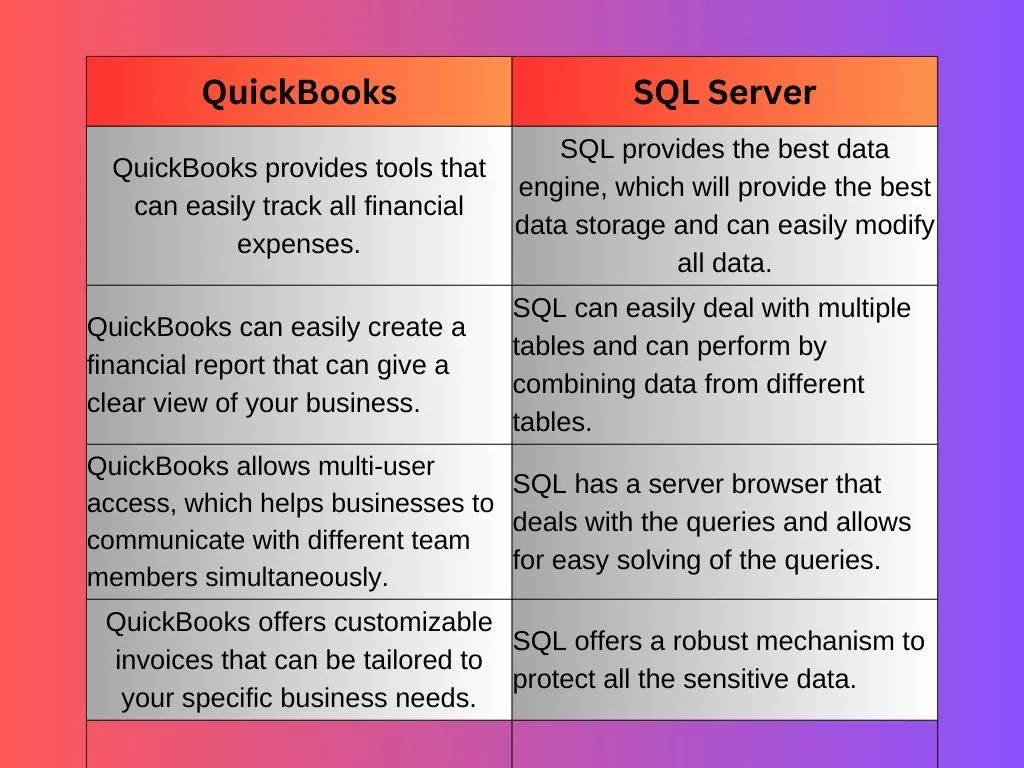
Several Benefits of QuickBooks SQL Server Integration
As experts say, more robust features will enhance your business; all users love to have advanced features. So, the QuickBooks SQL Server integration is the preferred choice for many, offering effortless benefits. Consider all the benefits of this integration mentioned below-
- QuickBooks SQL Server together improved the query and report to the next level.
- The integration changes the data visualization, in which users can analyze more about their business.
- This process allows synchronization of data between QuickBooks and SQL Server.
- QuickBooks SQL Server integration allows convenient data migration with high security.
- The integration automates the data visually and reduces manual data entry, which improves efficiency in work flows.
Steps to Integrate QuickBooks and SQL Server
When you think of QuickBooks SQL Server integrations, many ways will pop into your mind. But this is important to choose the right way to integrate. Remember to clean the data from SQL Server and review all the financial data correctly before integration. Look for a dedicated section on QuickBooks SQL Server integration, follow the instructions given below-
- First of all, you have to add QuickBooks to SQL Server.
- Then add all your financial data to SQL Server from QuickBooks.
- Make sure that the company files are accessible.
- Confirm that the QuickBooks SQL Server integration is in a remote location.
- Make a QuickBooks Linked Server and set up a tool if needed.
- Choose the SQL Server provider that will be best for your SQL Server integration.
- Now enter a data source name for this process.Now, open the SQL Server
- An ODBC driver is required to manage the data in SQL Server.
- Then, the SQL Server client provider.
- Now, link the client provider’s data to SQL Server.
- Now, you should update all QuickBooks data to SQL Server and start the integration process.
Why think of QuickBooks SQL Server integration?
The on-demand accounting software QuickBooks is experiencing rapid growth, with millions of users turning to it every month. QuickBooks offers every possible tool to fulfill all the needs of every business. But QuickBooks faces a key challenge that users want tools to manage their relational data, which QuickBooks can’t provide. So, users recognized QuickBooks SQL Server integration, which meet the needs of every user. This integration will surely bring the best out of the business.
Conclusion
We hope this guide will reach the core of expectations and will help you through the process. QuickBooks SQL Server integration is the best move, which will provide real-time insights to all businesses. For in-depth insights, feel free to reach out to our QuickBooks Support Number.